July 9, 2010
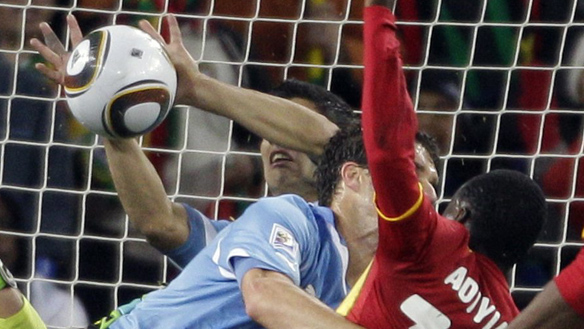
 Here we go again. A World Cup elimination game decided by an illegal play. But this one is of a different character than when Uruguay striker Luis Suarez used his hands to slap away a sure game-winning goal by Ghana. Suarez’s action was forthright, against the rules, duly penalized, but smart. Bad for the game, but not something one could brand as unethical. I proposed a rule change that would eliminate such plays.
But when Netherlands star Arjen Robben fell to the ground, writhing in pretended pain from pretended contact from the Brazilian defender (diving, in world footballspeak), he cheapened the game. The referee was fooled by Robben’s deception into awarding Holland a free kick, which was converted into the deciding goal in a 2- 1 win that ended Brazil’s hopes of another championship.
Robben cheated, and it got his team into the semi-finals against Uruguay, who they beat, 3-2. Now only Spain stands between the Dutch and the championship. It’ll be sad for the game if the Dutch win, their trophy forever tarnished by the way they won it.
There are three ways to reduce the incentive for players to dive: Read the rest of this entry »
34.064458
-118.451661
Tags: Arjen Robben, Brazil, cheating, deception, diving, Ghana, illegal play, incentive, Luis Suarez, Netherlands, penalty kick, rule change, soccer, Spain, suspension, TV replays, Uruguay, World Cup
Posted in Ethics-general, Sports | 3 Comments »
July 8, 2010
 I credited USC’s football coach, Lane Kiffin, with ethical behavior for releasing top recruit Seantrel Henderson from his commitment to play for the Trojans. I praised Kiffin for putting the player’s welfare first.
Jack Marshall pointed out that I had it wrong. His comment:
“But Bob—doesn’t that just encourage student athletes to renege on their commitments, or suggest that the “right thing to do” is allow students to break their agreements while the institution is held to them? Doesn’t sound right or fair to me. What happened to teaching students that a word is a bond, and that living up to a promise sometimes requires sacrifice?”
I stand corrected.
var sc_project=6152467;
var sc_invisible=1;
var sc_security=”2276aa67″;
34.064458
-118.451661
Tags: commitments, EthicsBob, Jack Marshall, Lane Kiffin, Seantrel Henderson, USC
Posted in Ethics-general, Sports | Leave a Comment »
July 8, 2010
 USC and its new football coach, Lane Kiffin, deserve big-time credit for ethical behavior. The athletic department, headed by ex-Trojan great Mike Garrett, has for months been reeling from scandal involving former Trojan stars Reggie Bush and O. J. Mayo, and from the sudden departure of coach Pete Carroll.
Carroll’s replacement, Lane Kiffin, soon looked like a miracle worker, assembling a group of high school seniors that ranked among the top recruiting classes in the nation, headed by 6’8, 337 pound Seantrel Henderson of Saint Paul, Minnesota, everybody’s choice as high school player of the year. Sports Illustrated described Henderson as “probably the most polished lineman of the past decade.” He plays left tackle, the position glorified by The Blind Side.
Henderson has now decided he doesn’t want to go to USC. If he transfers to another school, having signed a formal commitment to USC, NCAA rules require him to sit out for a year before becoming eligible to play. Unless the Trojans release him from his commitment. Which is what Kiffin just did.
Here’s a coach putting the good of the player first. Good news for a fan of both ethics and the Trojans.
var sc_project=6152467;
var sc_invisible=1;
var sc_security=”2276aa67″;
34.064458
-118.451661
Tags: ethics, football, Lane Kiffin, Mike Garrett, NCAA rules, O. J. Mayo, Pete Carroll, player of the year, recruiting, Reggie Bush, Seantrel Henderson, Sports Illustrated, The Blind Side, USC
Posted in Ethics-general, Sports | 3 Comments »
July 5, 2010
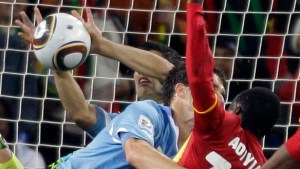 The World Cup has offered a lot of exciting soccer plus some serious controversy. The most controversial incident came in the quarter-final match between Uruguay and Ghana, in the 120th minute (that is, the last minute of overtime).
Ghana had been awarded a free kick, and the Ghana player unleashed a strike toward the net. The Uruguayan goal keeper leaped and missed the ball. It was the game-winning goal, until…Uruguayan forward Luis Suarez stretched his hands up and slapped the ball away.
Suarez’s action violated Law 12 of soccer’s official rules:
A player is sent off if he …denies the opposing team a goal or an obvious goalscoring opportunity by deliberately handling the ball (this does not apply to a goalkeeper within his own penalty area)
So Suarez was sent off (i.e., kicked out of the game) and Ghana was awarded a penalty kick—an unchallenged kick from twelve yards from the goal. Penalty kicks are converted to goals about three quarters of the time, but Ghana’s star striker, Asamoah Gyan, hit the crossbar with his kick. The game then proceeded to a shootout (alternating penalty kicks by either side), which Uruguay went on to win, 4-2. Ghana was eliminated from the World Cup, while Uruguay goes on to play the Netherlands in Tuesday’s semi-final match, but without Suarez, who was suspended for one game.
Did Suarez cheat? Not according to his coach Read the rest of this entry »
34.064458
-118.451661
Tags: cheating, ethics, football, Ghana, Gyan, hand ball, Law 12, penalty kick, quarter-final, Rajevac, red card, shootout, soccer, Suarez, Tabarez, Uruguay, World Cup
Posted in Ethics-general, Sports | 2 Comments »
July 1, 2010
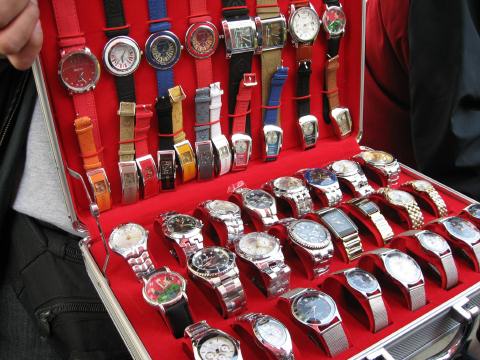
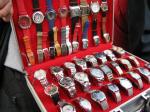 Rolex watches, Prada satchels, and Burberry scarves are nice, but not that nice. For far less than these cost you can get similar items that keep time better, hold more, and keep your neck warmer. Rolex-, Prada-, and Burberry-labeled goods are so desirable because they are positional goods. That’s the economists’ term for products whose value lies in their scarcity.
You can buy a genuine Rolex for $3960 at Amazon.com, or you can buy a knock-off at iReplicaStore.com for $115. Or on the street for $10. You won’t be able to tell the difference. The price comparisons for Prada and Burberry are similar. The real things sell for $1398 and $150, respectively, while the fakes go for $110 and $18 on the internet, much less on the street.
So what’s a person to do? You can fool everybody for a tenth the cost. And you won’t be alone: lots of people do it, even brag about their ten dollar Rolex. But “everybody does it” doesn’t make it ethical. The law gives Rolex, Prada, and Burberry exclusive use of their designs and labels. It’s called their intellectual property. You’d be stealing the intellectual property of the real brand. An ethical person doesn’t do that.
But maybe there’s another reason to shun knock-offs Read the rest of this entry »
34.064458
-118.451661
Tags: Amazon.com, Burberry positional goods, cheating, deception, Economist, ethics, fake designer goods, intellectual property, iReplicaStore.com, knock-offs, Prada, Rolex, scarcity, self-esteem, University of North Carolina
Posted in Business ethics, Ethics-general | 5 Comments »
June 30, 2010
 Apologies fall into three categories. Category 1 is the defiant apology: “I’m sorry if you think I did something wrong.”
Category 2 is the evasive apology: “I may have made an innocent mistake, and I’m sorry for it—if I actually did it.”
And there’s Category 3, the apology that’s so rare in politics it doesn’t yet have a name: “I did something wrong, and I’m sorry for it.” This used to be just called an apology, but the other types of apology make the old name inadequate. Just as technology made us replace “phone” with “dial phone,” and mail with “snail mail,” politics makes us put an adjective in front of “apology.” Call it the real apology.
Republican Senate candidate Mark Kirk of Illinois had a lot to apologize for. A month ago he apologized to the Chicago Tribune for a pile of whoppers about his 21-year record as a Navy Reserve intelligence officer: He had not come under fire in Iraq as claimed; had not participated in Operation Desert Storm; had not won the Navy’s award for intelligence officer of the year; had not commanded the Pentagon war room, and had not served in Operation Iraqi Freedom, the 2003 invasion of Iraq.
His apology was Category 2: “I am sorry, absolutely. You should speak with utter precision. You should stand on the documented military record. In public discourse, for high office, you should make sure that there is a degree of complete rigorous precession.” Read the rest of this entry »
34.064458
-118.451661
Tags: Alexi Giannoulias, Apologies, apology, Chicago Tribune, Connecticut Senate race, Illinois Senate race, intelligence officer of the year, lying, Mark Kirk, Richard Blumenthal, Vietnam
Posted in Ethics-general, Politics | Leave a Comment »
June 29, 2010
 When you make a mistake the ethical thing to do is to correct it as best you can and take action to prevent a recurrence. Right? Not if you’re the head of FIFA, the world’s soccer federation (football everywhere but in the USA) running the world’s biggest—by far—sporting event.
The 2010 World Cup in South Africa has been beset by ugly and blatant refereeing errors that cost the USA team a win against Slovenia, and disadvantaged England and Mexico in their losses to Germany and Argentina.
The most egregious error was the referee disallowing a clear England goal when Frank Lampard’s shot hit the crossbar and bounced a good yard beyond the goal. Instead of tying Germany, 2-2, a disappointed England team went on to lose, 3-1. Just three hours later, another referee gave Argentina a go-ahead goal on a ball hit by a clearly offside Carlos Tevez (see photo).
When the Tevez play was replayed on the stadium’s giant TV screen, the fans erupted and the Mexican players protested to the referee. But the referee held his indefensible ground.
FIFA’s response? “FIFA will not make any comments on decisions of referees on the field of play.” But they did admit one mistake: close plays are not to be shown on stadium TV screens anymore, because it incites fans and leads to on-field arguments. Yes, the truth often does that.
var sc_project=6152467;
var sc_invisible=1;
var sc_security=”2276aa67″;
34.064458
-118.451661
Tags: Argentina, Carlos Tevez, cover-up, England, ethics, FIFA, football, Frank Lampard, Germany, Mexico, offside, questionable plays, referee errors, replay, soccer, South Africa, stadium TV, World Cup
Posted in Ethics-general, Sports | Leave a Comment »
June 28, 2010
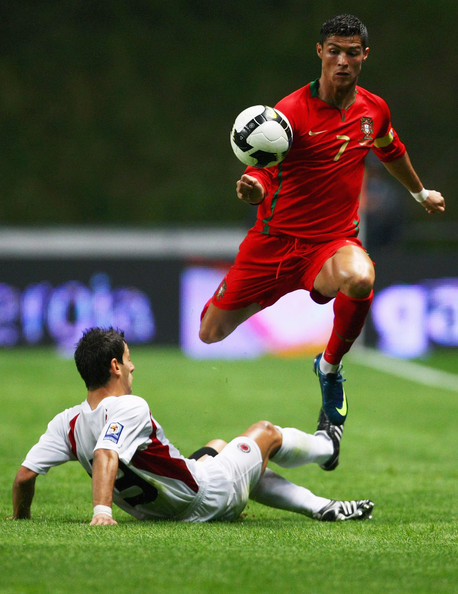
 I watched the USA soccer team win its group in the World Cup, then lose to Ghana in the knockout round. Then I turned to my second favorite team, Brazil. I’m part of a World Cup television audience of more than a billion fans, and like most of them I lusted after the official team jerseys—a white USA shirt, perhaps, with number 10, Donovan, on the back, or a brilliant yellow and green Brazil shirt, also with number 10, Kaká. No, I think I like best the red and green number seven jersey of the world’s best player, Portugal’s Christiano Ronaldo. Seventy dollars for the home jersey, sixty for the more colorful away version. But I won’t be buying any.
All these official jerseys are made by Nike. Well, actually, Nike doesn’t make any sports gear. The shirts are made by a Nike contractor in Indonesia, whose workers earn $4/day, barely enough to pay rent, transportation, water, and two small bowls a day of rice and vegetables.
Nike long ago took the position that it has no responsibility for the pay or working conditions in the factories that make Nike gear, but over the past ten years it has slowly Read the rest of this entry »
34.064458
-118.451661
Tags: Brazil, Business ethics, Christiano Ronaldo, ethics, Indonesia, Jim Keady, Kaká, Landon Donovan, Los Angeles Times, Nike, Nike contractor, Portugal, team jerseys, USA soccer, working conditions, World Cup
Posted in Business ethics, Ethics-general, International, Sports | Leave a Comment »
June 24, 2010
 General David Petraeus had it made. For the past twenty months he has led United States Central Command, with responsibility for actual and potential military operations from Egypt to Pakistan. He has lived the luxurious life of a four-star general at MacDill Air Force Base in Tampa—one of the most prestigious, glamorous, and comfortable assignments the U.S. military has to offer. After spending most of the last ten years separated from his family on assignments on Bosnia and Iraq—the last two as commander of the multi-national force there—he was on the verge of retirement, praised as America’s greatest general, perhaps the greatest since the glory days of MacArthur, Patton, and Eisenhower.
Then General Stanley McChrystal invited a reporter from Rolling Stone magazine to live with his command in Afghanistan for weeks, where the reporter chronicled for the world the contempt that McChrystal and his senior staff had for the President and his national security team. Obama fired McChrystal and asked Petraeus to take a demotion, going from McChrystal’s boss to his replacement. And going from palatial four-star housing with his wife in Tampa to battlefield accommodations in Afghanistan.
Petraeus said yes sir, once again answering his country’s call. His coming service as commander of coalition forces in Afghanistan may enhance or may diminish his reputation as a great general. There’s no doubt, however, that it will remind America of the meaning of the West Point ethic: Duty, Honor, Country.
Read The Ethics Challenge: Strengthening Your Integrity in a Greedy World
var sc_project=6152467;
var sc_invisible=1;
var sc_security=”2276aa67″;
34.064458
-118.451661
Tags: Afghanistan, Bosnia, Central Command, coalition forces, demotion, Duty Honor Country., Eisenhower, ethics, General David Petraeus, General Stanley McChrystal, Iraq, MacArthur, MacDill Air Force Base, multi-national force, Obama, Pakistan, Patton, Rolling Stone, West Point
Posted in Ethics-general, military, Politics | Leave a Comment »
June 18, 2010
 Turkey, long America’s most reliable, and Israel’s only, ally in the Muslim world, is now being called anti-American, anti-Israel, and most alarming, Islamist, especially after the deadly May 31 incident when Turkish activists sailed into an Israeli blockade of Gaza and came off second best.
Turkey’s Prime Minister, Recap Erdogan (pronounced Re-jep ERD-uh-WAN) is the favorite whipping boy of just about anybody who is for Israel or against Iran, radical Islamists, or Muslims in general. It’s ironic that Erdogan, who has led Turkey toward most of the western democratic-style reforms demanded by the European Union as a condition for Turkey’s acceptance, is at now being accused by many, including many Turks, of wanting to return Turkey to the Muslim caliphate of pre-Ataturk days.
One of the West’s most insightful observers of Turkish affairs is South African journalist and author Hugh Pope, who for years headed the Istanbul office of the Wall Street Journal. Pope has an op-ed in today’s Haaretz, Israel’s most respected newspaper headlined Erdogan is not the bogeyman. In it he debunks the idea of an “Islamist foreign policy for Turkey, Read the rest of this entry »
34.064458
-118.451661
Tags: Ataturk, blockade, caliphate, democratic-style reforms, Erdogan is not the bogeyman, ethics, European Union, Gaza, Haaretz, Hugh Pope, Iran, Islamist foreign policy, Israel, May 31 incident, Muslim world, Palestinians, radical Islamist, Recap Erdogan, Turkey, Wall Street Journal
Posted in Ethics-general, International, Politics, Tolerance | Leave a Comment »
 Here we go again. A World Cup elimination game decided by an illegal play. But this one is of a different character than when Uruguay striker Luis Suarez used his hands to slap away a sure game-winning goal by Ghana. Suarez’s action was forthright, against the rules, duly penalized, but smart. Bad for the game, but not something one could brand as unethical. I proposed a rule change that would eliminate such plays.






 Ethics Bob