Archive for the ‘Politics’ Category
April 28, 2010
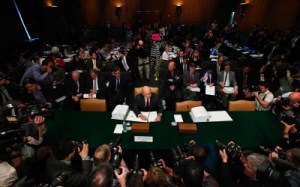 The Senate held a ten-hour hearing yesterday on Goldman Sachs’s role in the financial crisis. The question for the committee was whether new laws were needed to reform the financial system; the question for me was whether Goldman Sachs—America’s most prestigious investment bank—was serious about ethics.
The hearing was long, the members were irritable, the subject was complicated, and the Goldman Sachs executives were evasive when asked such tough questions as whether they had any obligation to act in the best interest of their clients. But two exchanges tell us unequivocally about ethics at Goldman Sachs. First, Chairman Carl Levin (D-MI) and Goldman Sachs Chief Financial Officer David Viniar.
LEVIN: And when you heard that your employees, in these e-mails, when looking at these deals said, God, what a shitty deal, God what a piece of crap — when you hear your own employees or read about those in the e-mails, do you feel anything?
VINIAR: I think that’s very unfortunate to have on e-mail. [Laughter and groaning from the audience]
LEVIN: On an e-mail?
VINIAR: Please don’t take that the wrong way. I think it’s very unfortunate for anyone to have said that in any form.
LEVIN: How about to believe that and sell them? (more…)
34.064458
-118.451661
Tags:Carl Levin, clients, David Viniar, e-mails, ethics, financial reform, Goldman Sachs, Lloyd Blankfein, Senate hearing¸ financial crisis, shitty deal
Posted in Business ethics, Ethics-general, Politics | 2 Comments »
April 24, 2010
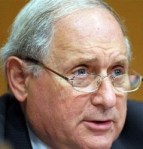
 In the wake of Wall Street scandals, collapses, bailouts, bonus billions, record profits, and now, according to the SEC, charges of fraud, the big show moves to Washington on Tuesday when the Senate Permanent Subcommittee on Investigations, chaired by Carl Levin (D-MI) will grill Lloyd Blankfein, Goldman Sachs CEO, and six current and former Goldman people, including Fabrice “Fabulous Fab” Tourre. The show starts at 10 AM EDT.
Levin is a very bright, very tough, inquisitor who is not one of the 46 senators who have gotten major contributions from Goldman. Nor is the ranking Republican, Tom Coburn (R-OK). The committee has a long history of changing Americans’ attitudes and behaviors, going back to 1921. It may well start to change the way Americans think about ethics and business.
Blankfein will testify last. He’ll face an awful dilemma: Will he defend Goldman’s behavior—described by Business Week’s Michael Lewis as creating a billion dollar bond package to fail, tricking and bribing the ratings agencies into blessing the package, then selling it to a slow-witted German?
Or will he say that Fabulous Fab’s deal was inconsistent with Goldman’s ethical standards, and thereby give credence to the SEC’s charge of fraud?
What would you do?
34.064458
-118.451661
Tags:bailouts, bonus billions, Carl Levin, ethics, Fabrice “Fabulous Fab” Tourre, fraud, Goldman Sachs, Lloyd Blankfein, Michael Lewis, ratings agencies, SEC, Senate Permanent Subcommittee on Investigations, Tom Coburn, Wall Street
Posted in Business ethics, Ethics-general, Finance, Politics | 3 Comments »
April 23, 2010
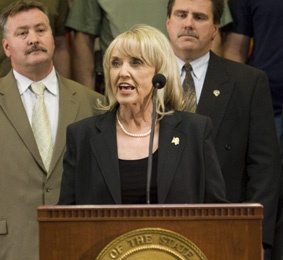 Arizona Gov. Jan Brewer today signed into law what President Obama had just called an irresponsible act that “threaten[s] to undermine basic notions of fairness that we cherish as Americans, as well as the trust between police and their communities that is so crucial to keeping us safe.”
The new law makes it a crime to lack proper immigration paperwork and requires police, if they have reasonable suspicion that someone is in the country illegally, to determine their immigration status. It also bars people from soliciting work as day laborers.
The President made his remarks at a naturalization ceremony for 24 active-duty military people. He acknowledged that the Arizona action resulted from “our failure to act responsibly at the federal level,” as he called for Congress to enact comprehensive immigration reform.
So we now wait and see whether the new law increases or decreases the security of the people of Arizona. To her credit, Gov. Brewer spoke forcefully about her determination not to tolerate racial profiling by police officers. On the other hand, when a reporter asked her what an illegal immigrant looked like, she answered simply, “I don’t know.”
She said she signed the law to combat the “murderous greed of drug cartels, drop houses, kidnappings, and violence.” We can expect that the murderous greedy drug kingpins will no longer congregate in Wal-Mart parking lots looking for day labor.
Read The Ethics Challenge: Strengthening Your Integrity in a Greedy World
34.064458
-118.451661
Tags:Arizona law, comprehensive immigration reform, day laborers, drop houses, drug cartels, ethics, fairness, immigration, Jan Brewer, kidnappings, naturalization ceremony, police, President Obama, racial profiling, reasonable suspicion, Wal-Mart parking lots
Posted in Ethics-general, military, Politics, Tolerance | 3 Comments »
April 18, 2010
 Screaming Frog Productions has produced a gem of a movie that helped me to think about the issue of immigrants—legal and illegal—who congregate to seek work as day laborers. It was directed by Jonathan Browning and has been shown at over 150 film festivals all around the world and won over 30 awards. Watch The Job, a three-minute movie that changed the way I think of day laborers. And made me laugh heartily.
The great first century Jewish teacher, Hillel, was asked—according to the Talmud—by a cynic to teach him the whole law (Torah) while standing on one foot. That was easy for Hillel. “What is hateful to you, do not do to your neighbor. This is the whole Torah; all the rest is commentary. Go and learn it.”
Hillel was expressing the Golden Rule, which is at the center of ethical behavior in Judaism, Christianity, Islam, Hinduism, Shintoism, in fact in every religion we know of, dating from the earliest recorded history. It’s hard enough to practice the Golden Rule when your “neighbor” is literally your neighbor, but it gets progressively harder as the “neighbor” becomes more removed from one’s experience. The Job made it easier for me.
34.064458
-118.451661
Tags:day laborers, ethical behavior, ethics, Golden Rule, Hillel, immigrants, Jonathan Browning, Screaming Frog Productions, The Job
Posted in Ethics-general, International, Politics, Tolerance | 5 Comments »
April 15, 2010
Ethics can be confusing. Like the case of illegal immigration: how do we decide between compassion and legality? {Disclosure: My ideas may be affected by my family experience. My grandparents came here from Russia and Germany in the 1880s, when there was no such thing as illegal immigration. You just had to be free of TB and you were admitted. Had they not been admitted the whole family would likely have been subjected to fierce anti-Semitism, then murdered in the Holocaust.)
The Arizona House of Representatives this week passed America’s toughest state law against illegal immigration. It makes it a crime to lack proper immigration paperwork and requires police, if they suspect someone is in the country illegally, to determine their immigration status. It also bars people from soliciting work as day laborers. Its author, state Sen. Russell Pearce, explains, “When you make life difficult, most will leave on their own.”
I certainly believe in making life difficult for lawbreakers, but there’s serious collateral damage here. What about the “foreign-looking” people who will be challenged to prove their legal status? Like Graciela Beltran of Tucson, who, the Los Angeles Times reports, was asked for immigration papers while boarding a bus. And the other dark-skinned people who will be “profiled.”
And along with the lawbreakers there are innocents, like the U.S.-born children of illegals, who face having their parents deported. Or who face hunger because their fathers can no longer find day work from the Walmart parking lot.
Americans have contributed to the problem by allowing so many to overstay their visas or to enter illegally. Now it seems to me that we have an obligation to be humane in our treatment.
What’s an ethicist to conclude? Let me know your opinion.
34.064458
-118.451661
Tags:. Russell Pearce, anti-Semitism, Arizona House of Representatives¸ immigration status, collateral damage¸ Graciela Beltran, compassion, day laborers, ethics, Holocaust, illegal immigrants, illegal immigration, profiling, Walmart parking lot
Posted in Ethics-general, International, Politics, Tolerance | 12 Comments »
April 14, 2010
 Many Americans yearn for a return to civility in our political life. We’re saddened by politicians of all stripes demonizing people they disagree with, and even demonizing people they agree with when there’s a political edge to be gained. This column has long admired the political philosophy of Christian theologian Reinhold Niebuhr, who wrote, ‘The temper of and integrity with which the political fight is waged is more important for the health of our society than the outcome of any issue or campaign.”
This week Sen. Tom Coburn (R-OK) raised the temper and integrity of the political fight at a town meeting with his Oklahoma constituents. When a woman complained bitterly that the IRS was going to put people in prison for not purchasing health insurance, Coburn rebuked her:
“That makes for good TV news on Fox, but that isn’t the intention. I’m disturbed that we get things like what this lady said and others have said on other issues that are so disconnected from what I know to be fact. (more…)
34.064458
-118.451661
Tags:civility, CNN, demonizing, ethics, Fox News, health insurance, IRS, New York Times, nice lady, Oklahoma, Pelosi, political fight, politicians, Reinhold Niebuhr, Reinhold Niebuhr award., Sen. Tom Coburn, town meeting, TV news, Wall Street Journal, Washington Post
Posted in Ethics-general, Politics, Tolerance | 2 Comments »
April 13, 2010

John McCain is a big fat liar. It’s sad how someone who has been so widely admired can tell such a whopper. McCain told Newsweek, “I never considered myself a maverick.”
No, except for his autobiographical Worth the Fighting For: The Education of an American Maverick, and the Heroes Who Inspired Him. And except for all his campaign ads calling himself and Sarah Palin mavericks. And thousands of times during the 2008 campaign.
McCain is in the fight of his Senate career: J. D. Hayworth is mounting a serious challenge for the Republican nomination, and the outcome is in doubt. To increase his chances against a challenge from the right McCain seems to have decided he needed to run away from his past and from his self-identification as a maverick.
Sad. And revolting.
34.064458
-118.451661
Tags:ethics, J.D.Hayworth, lies, McCain, Newsweek, Palin
Posted in Ethics-general, Politics | 3 Comments »
March 23, 2010
 Hillary Clinton promised the voters of New York state in 2000 that if elected she would serve a full term. But by 2003, with George W. Bush’s popularity falling he appeared beatable, if the Democrats nominated the right person. Most of the Democratic political heavyweights thought the right person was Hillary.
Should she or shouldn’t she? She summoned all her inner circle—husband Bill, daughter Chelsea and her boyfriend, and four veterans of the Clinton White House—to one final meeting at the Clinton home in Westchester County. Game Change, the dishy story about the 2008 election by John Heilemann and Mark Halperin, tells what happened.
“One by one, Hillary polled the group, listening carefully to what each of them had to say. [All told her she should run, but] there was one dissenter in the room. Chelsea believed that her mother had to finish her term, that she’d made a promise (more…)
34.064458
-118.451661
Tags:. Game Change, Chelsea Clinton, Clinton White House, code of ethics, Democrats, election promises, Enron, ethics, George W Bush, Hillary Clinton, John Heilemann, Lockheed-Martin, Mark Halperin, Quick Quiz
Posted in Ethics-general, Politics | Leave a Comment »
March 22, 2010
 “Nigger!” shouted by a demonstrator at Rep. John Lewis (D-GA) as he was leaving the Capitol Saturday. “Faggot!” at Rep. Barney Frank (D-MA). Words not enough, a demonstrator spat on Rep. Emanuel Cleaver (D., Mo.).
To their credit, some on the right objected. House Minority Leader John Boehner (R-OH), called the actions by some protesters “reprehensible.” Amy Kremer, coordinator of the Tea Party Express, told Fox News, “I absolutely think it’s isolated. It’s disgraceful and the people in this movement won’t tolerate it because that’s not what we’re about.”
While nigger and faggot cross the line for Tea Partiers, they may be the logical next step after socialist, communist, and Nazi. If you agree with the so-far-unnamed Republican congressman who shouted “baby killer” from the House floor (more…)
34.064458
-118.451661
Tags:Amy Kremer, baby killer, Barney Frank, Bart Stupak, communism, Connie Mack, Constitution, Emanuel Cleaver, faggot, John Boehner, John Lewis, Nazi, Nigger, Obamacare, Reinhold Niebuhr, Republican, socialism, Tea Party Express
Posted in Ethics-general, Politics | Leave a Comment »
March 19, 2010
 On the eve of a historic vote in the House on health care reform Republicans aren’t conflicted. They’ll all vote ‘no.’ But on the Democratic side it’s not so easy. Some members who favor reform are in districts that poll strongly against; some members who oppose reform are in districts that poll in favor. Both groups are conflicted: vote their conscience or vote their constituents?
Marjorie Margolies argues, in an op-ed in Thursday’s Washington Post, that members should vote their conscience. She’s a voice worth paying attention to, since her vote of conscience in favor of President Clinton’s budget proposal is generally considered to have led directly to her defeat in the 1994 election. But if you think Margolies’ advice just serves her desire to get health care reform passed, consider what the father of modern conservatism, Edmund Burke had to say on the subject in 1774.
Burke’s Speech To The Electors Of Bristol was well known to Jefferson, Madison, and the other Founding Fathers. Many political scientists consider it one of the documents underlying our Constitution. Burke told his constituents that a representative owes them “his judgement; and he betrays, instead of serving you, if he sacrifices it to your opinion.”
34.064458
-118.451661
Tags:. Reelection, Clinton budget, conscience, Constitution, Edmund Burke, ethics, Founding Fathers, health care, Jefferson, Madison, Marjorie Margolies, political science, Speech To The Electors Of Bristol
Posted in Ethics-general, Politics | 4 Comments »
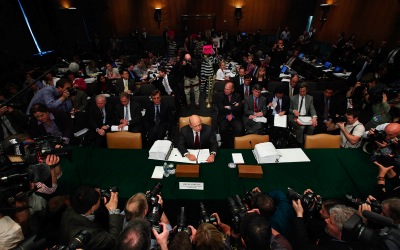 The Senate held a ten-hour hearing yesterday on Goldman Sachs’s role in the financial crisis. The question for the committee was whether new laws were needed to reform the financial system; the question for me was whether Goldman Sachs—America’s most prestigious investment bank—was serious about ethics.







 Ethics Bob