Archive for the ‘Business ethics’ Category

A wallet-sized code of ethics

May 11, 2010

There’s something about bureaucracy that violates my sense of ethics. Bureaucracy represses one’s humanity. Humans want to make a difference in their lives, but bureaucracy forces conformity and sameness. One definition in the American Heritage Dictionary is “an administrative system in which the need or inclination to follow rigid or complex procedures impedes effective action.”

The bureaucratic system is founded on rules, supervision and enforcement by specialists and inspectors to make sure workers follow the rules, even when the rules deviate from common sense.

We need to move beyond it, but moving beyond it means shifting to a different form of control, one based on a strong sense of mission and a culture of trust, with authority and responsibility shifted from the few at the top to the many front-line workers.

This shift also requires that the organization have a strong ethical grounding. Ethics must replace the missing rules, but in many organizations what passes for ethics is merely another set of rules to comply with, and ethics training usually consists of badgering workers about bribery, conflict of interest and favoritism.

Enron had a nice 65-page code of ethics. The International City/County Management Association has a pretty good code of ethics except that it’s 2000 words long, has a 3200-word supplementary “Rules of Procedure for Enforcement,” and is written by lawyers or at least by people who have mastered esoteric, lawyerly writing. Most people can’t live by the ICMA code because they simply can’t remember any of it. (more…)
Goldman Sachs fails the ethics challenge

April 28, 2010

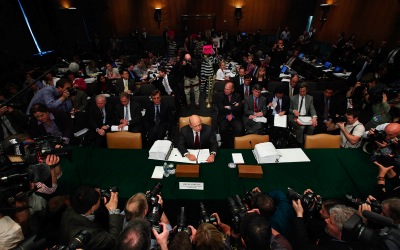
The Senate held a ten-hour hearing yesterday on Goldman Sachs’s role in the financial crisis. The question for the committee was whether new laws were needed to reform the financial system; the question for me was whether Goldman Sachs—America’s most prestigious investment bank—was serious about ethics.

The hearing was long, the members were irritable, the subject was complicated, and the Goldman Sachs executives were evasive when asked such tough questions as whether they had any obligation to act in the best interest of their clients. But two exchanges tell us unequivocally about ethics at Goldman Sachs. First, Chairman Carl Levin (D-MI) and Goldman Sachs Chief Financial Officer David Viniar.

LEVIN: And when you heard that your employees, in these e-mails, when looking at these deals said, God, what a shitty deal, God what a piece of crap — when you hear your own employees or read about those in the e-mails, do you feel anything?

VINIAR: I think that’s very unfortunate to have on e-mail. [Laughter and groaning from the audience]

LEVIN: On an e-mail?

VINIAR: Please don’t take that the wrong way. I think it’s very unfortunate for anyone to have said that in any form.

LEVIN: How about to believe that and sell them? (more…)

An ethics challenge to Wall Street…from the U. S. Senate, of all places

April 24, 2010

In the wake of Wall Street scandals, collapses, bailouts, bonus billions, record profits, and now, according to the SEC, charges of fraud, the big show moves to Washington on Tuesday when the Senate Permanent Subcommittee on Investigations, chaired by Carl Levin (D-MI) will grill Lloyd Blankfein, Goldman Sachs CEO, and six current and former Goldman people, including Fabrice “Fabulous Fab” Tourre. The show starts at 10 AM EDT.

Levin is a very bright, very tough, inquisitor who is not one of the 46 senators who have gotten major contributions from Goldman. Nor is the ranking Republican, Tom Coburn (R-OK). The committee has a long history of changing Americans’ attitudes and behaviors, going back to 1921. It may well start to change the way Americans think about ethics and business.

Blankfein will testify last. He’ll face an awful dilemma: Will he defend Goldman’s behavior—described by Business Week’s Michael Lewis as creating a billion dollar bond package to fail, tricking and bribing the ratings agencies into blessing the package, then selling it to a slow-witted German?

Or will he say that Fabulous Fab’s deal was inconsistent with Goldman’s ethical standards, and thereby give credence to the SEC’s charge of fraud?

What would you do?

Is it OK to cheat as long as it’s not illegal? Does Goldman Sachs say yes?

April 20, 2010

After the Securities and Exchange Commission last Friday charged America’s most respected financial firm, Goldman Sachs, with defrauding investors, CNN’s Rick Sanchez asked, “Is it OK to cheat as long as it’s not illegal?

Goldman says no: CEO Lloyd Blankfein left a voicemail on every Goldman worker’s phone saying,

“Goldman Sachs has never condoned and would never condone inappropriate activity by any of our people. On the contrary, we would be the first to condemn it and take immediate and appropriate action.”

We’ll see. According to the SEC complaint, Goldman Sachs was approached by hedge fund operator John Paulson (no relation to ex-Treasury secretary and ex-Goldman CEO Henry Paulson), who wanted to bet against sub-prime mortgages—that is, he wanted to bet that their value would fall as their riskiness became clear and as borrowers defaulted.

Working with G-S vice president Fabrice Tourre (“Fabulous Fab,” as he called himself), Paulson hand-picked a billion dollar portfolio of mortgage-backed securities that he considered the absolute riskiest and most likely to fail. (more…)

U of Wisconsin rejects Nike business ethics

April 13, 2010

The admirable website, EthicsAlarms.com, praised the U of Wisconsin today for ending its contract with Nike, the result of a 15-year effort by my friend Jim Keady.

Keady’s 15-year effort to get Nike to take some responsibility for the workers who make products with the swoosh has included living for three months in Indonesia on $1.25 a day, the wage in a local factory that makes shoes for Nike. He’s a Jesuit-educated true believer in Catholic ideas (not necessarily practices) of charity.

More big bad behavior from corporate America

March 12, 2010

Do you think the laws keep corporate executives from undeservedly enriching themselves at the expense of the public and their own shareholders? We already know about outright theft at Adelphia, fiddling with the books at MCI-WorldCom,. All of these were violations of laws intended to protect the public, and many of the perpetrators are now in jail.

But avarice will find a way. If you’re a CEO and you know bad news about your company is about to break, it’s against the law for you to sell stock in the company until the news is out. And even if you could sell your stock you could face a big tax bill for the money you’ve made.

It turns out you’re not helpless. While you can’t sell your stock you can hedge it by buying any of a variety of financial instruments (more…)